Home › Massage Types › Foot Massage and Thai Reflexology
Foot Massage and Thai Reflexology
นวดฝ่าเท้า (nuat fa thao, 'sole of foot massage'); the reflexology framing is นวดกดจุดสะท้อนเท้า (nuat kot chut sathon thao, 'foot reflex point massage'); also called nuat tao
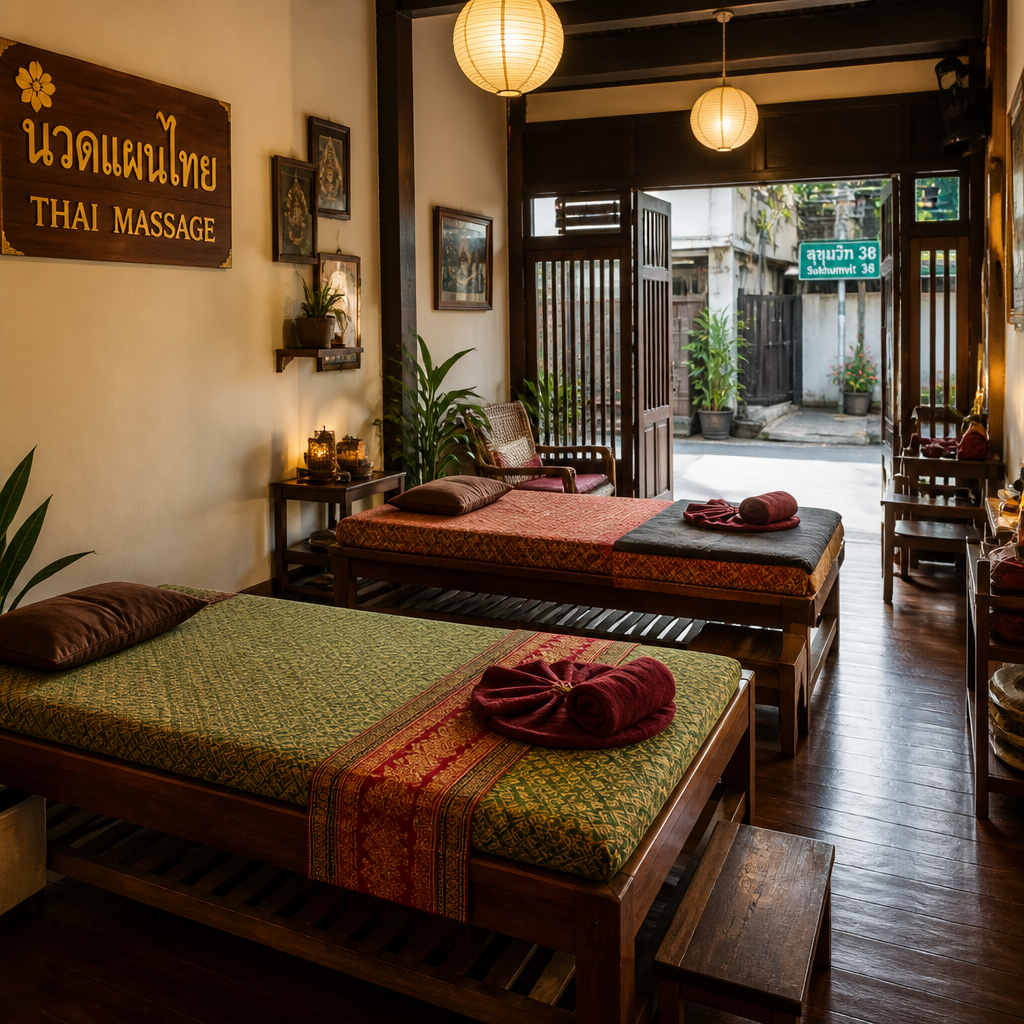
Thai foot massage is the most accessible treatment on any Thai shop menu: you sit back in a reclining chair, fully clothed except for shoes and socks, trousers rolled to the knee, and the therapist works your feet and lower legs for an hour. It combines thumb pressure on specific points of the sole with kneading of the foot and calf, joint mobilisation of toes and ankle, and stretching, usually with balm or oil and often with a short wooden stick used to concentrate pressure on the sole. Most shops finish with several minutes on the shoulders, neck and head while you are still in the chair. It is cheap, requires no undressing, is the easiest first massage for a nervous visitor, and is genuinely restorative after long days walking. The reflexology component — that specific sole points correspond to distant organs — is a theoretical framework, not a demonstrated physiological mechanism.
How it is done: Foot Massage and Thai Reflexology
The therapist starts with a footbath or a wipe-down, then applies balm or oil and begins with broad warming strokes over the foot and calf. Thumb pressure follows: sustained perpendicular pressing along three routes on the sole, each point held several seconds until a firm but tolerable sensation registers, then repeated. Knuckles are used to work the sole broadly; a short rounded wooden stick, roughly pen-sized, concentrates pressure into small areas of the arch and heel and lets the therapist reach depth without exhausting their thumbs. Toes are pulled, rotated and individually flexed, sometimes cracked; the ankle is circled and dorsiflexed; the Achilles and calf are squeezed and kneaded; the shin and tibialis anterior are thumbed upward. Pressure on the sole is often the most intense part of the session — sharp spots are usually simple tenderness rather than a diagnostic signal about your kidneys, whatever the wall chart implies. The therapist typically alternates feet, completing a full pass on one before switching, then returns for a second lighter pass. Work commonly extends up to the knee, and many shops close with percussive tapping down the legs, a brief calf and thigh sequence, and five to ten minutes on shoulders, neck, arms and scalp while you remain seated. Hot towels finish it.
Who it suits: Foot Massage and Thai Reflexology
It is used for tired, aching feet, plantar and calf tightness, general relaxation, and as a low-commitment way to unwind after long days on foot — which describes most travel days in Thailand. There is reasonable rationale for improved ankle and toe range of motion and reduced local muscle tension, and one Thai randomised trial found improvements in balance, joint range and foot sensation in diabetic patients with peripheral neuropathy after a two-week course. Many people find it markedly calming, and it is a common choice for sleep difficulty. What it is not is a treatment for internal disease. Claims that pressing a sole point clears the liver, regulates the kidneys or detoxifies the body are the reflexology framework being taken literally, and the clinical evidence does not support them. Enjoy the chart as tradition, not diagnosis. If you have foot pain that persists, it needs a podiatrist or doctor, not more reflexology.
How long to book
60 minutes is the standard unit and by far the most common; 30-minute versions are widely sold as add-ons, and 90-minute sessions usually mean feet plus extended leg, shoulder and head work.
What it costs
Street and local shops: roughly 150-300 baht per hour, with Khao San-area and small neighbourhood shops at the lower end. Mid-market shops: roughly 250-500 baht per hour. Hotel and boutique spas: roughly 500-900 baht per hour, with high-end Chiang Mai and Bangkok spas around 900-1,300. Thirty-minute add-ons typically run 150-300 baht.
Safety: who should be careful
Tell the therapist about foot conditions and medical history before you sit down. Diabetes deserves specific mention: reduced foot sensation means you may not feel pressure that is too firm, and diabetic feet are vulnerable to skin breakdown and slow healing, so ask a doctor first and always mention it. Avoid foot massage over athlete's foot, plantar warts, cellulitis, open wounds, ulcers, unhealed blisters or any infection, since these can spread or worsen. Ask a doctor before booking if you have any history or risk of deep vein thrombosis, calf pain, swelling or warmth in one leg, significant varicose veins, peripheral arterial disease, gout in an acute flare, a recent foot or ankle fracture or sprain, or osteoporosis. Pregnancy is treated cautiously by many Thai shops, which decline the first trimester; the traditional caution about specific ankle points is not well evidenced but discussing it with your midwife or doctor is sensible. Postpone if you have a fever or acute illness. Speak up if pressure is painful rather than firm — bruising and lingering soreness usually mean it was too hard.
What the evidence says
The reflexology evidence base is weak and has been for some time. Ernst, Posadzki and Lee's 2011 systematic review update in Maturitas assessed 23 randomised controlled trials and concluded that the best clinical evidence does not convincingly show reflexology to be effective for any medical condition; methodological quality was frequently poor, and among higher-quality trials the results skewed negative. Australia's 2024 Natural Therapies Review reached similarly unfavourable conclusions. The more promising evidence is for foot massage as mechanical and sensory intervention rather than as organ-mapping therapy: Chatchawan and colleagues (2015, Medical Science Monitor Basic Research) randomised 60 type-2 diabetic patients with peripheral neuropathy to Thai foot massage or control, three sessions weekly for two weeks, and found faster Timed Up and Go performance and improvements in range of motion and monofilament foot sensation in the massage group. That is one small, short trial with no long-term follow-up. Treat foot massage as pleasant and plausibly useful for local mobility and balance; treat reflexology claims sceptically.
Therapist Perspective
The wooden reflexology stick should support the hands, not replace them. Kern advises therapists to use it only when needed, gliding the wide rounded end over a well-oiled sole rather than jabbing with the pointed tip. If it's poking hard, ask for hands instead.
— Shama Kern, founder, Thai Healing Massage Academy Source
Where to get foot massage
99 Thai Massage Huahin — Central Hua Hin
A Serene Beach Spa - Koh Samui — Taling Ngam
All Day Massage And Sea — Ao Nang
Andaman Massage Kamala — Kamala · from 350 THB · open late
Asia Herb Association — Benchasiri Park — Phrom Phong · from 700 THB · open late
Asia Herb Association — Sukhumvit 24 — Phrom Phong · from 700 THB · open late
Asia Herb Association — Sukhumvit 4 (Nana) — Nana · from 700 THB · open late
Aura Thai Massage — Phuket Town (Wichit) · from 350 THB · open late
See all 143 shops offering foot massage →
Foot Massage by city
Bangkok · Pattaya · Phuket · Chiang Mai · Hua Hin · Krabi · Koh Samui
Wellness guides
Thai Massage for Recovery: What Helps, What the Evidence Says — Can Thai massage speed recovery after hard exercise, treks or long journeys? What studies on soreness and fatigue found, and when to rest or see a doctor.
Thai Massage for Sleep: What Helps, What the Evidence Says — Can a Thai massage help you sleep better? What the small Thai trials found, which styles suit an evening session, and when poor sleep needs a doctor, not a spa.
Thai Massage for Stress Relief: What Helps, What the Evidence Says — Does Thai massage really reduce stress? What trials on anxiety, heart rate variability and cortisol found, which styles relax most, and when to seek more help.
Other massage types
Aromatherapy Massage · Head and Shoulder Massage · Herbal Compress Massage · Sports Massage · Thai Oil Massage · Tok Sen Massage · Traditional Thai Massage