Home › Massage Types › Tok Sen Massage
Tok Sen Massage
ตอกเส้น (tok sen) — 'tok' meaning to tap or hammer, 'sen' the traditional energy lines
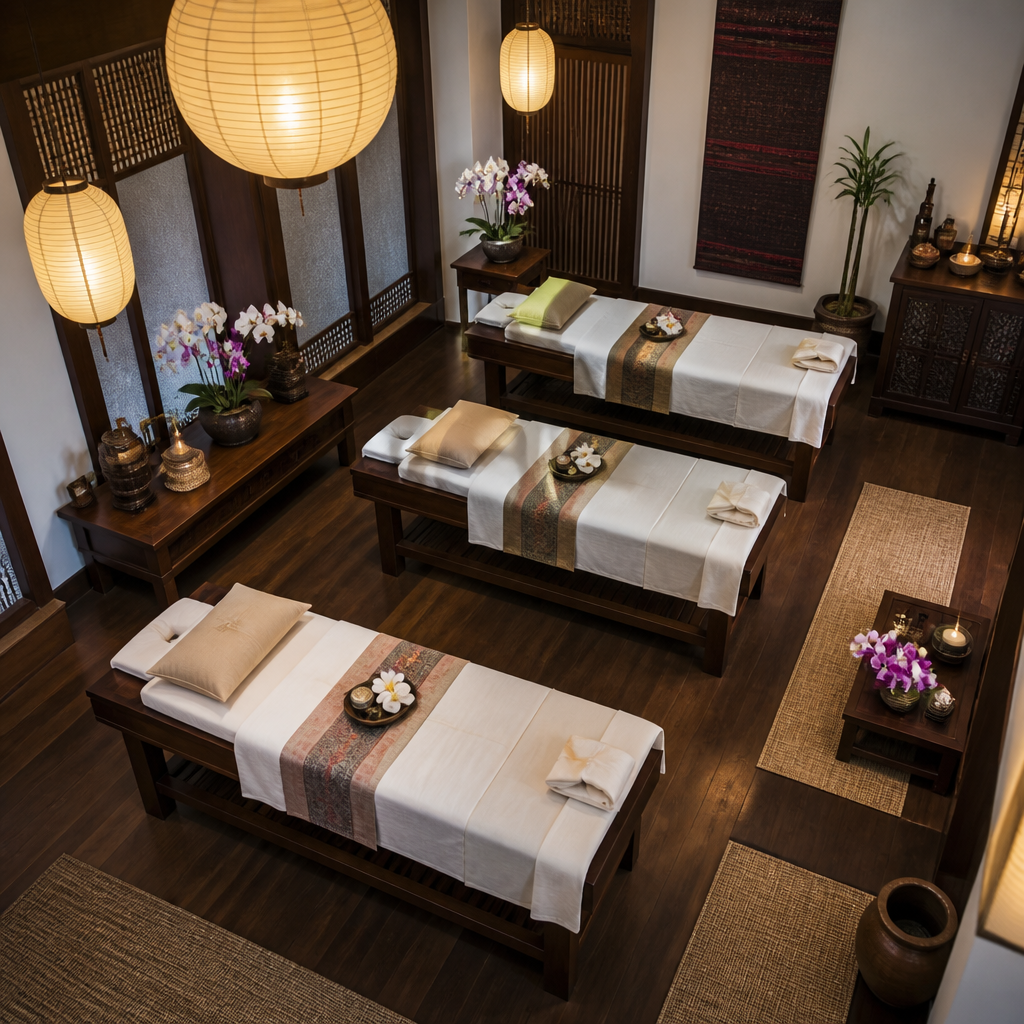
Tok Sen is the northern Thai treatment where the therapist taps you with a wooden mallet. A small hammer strikes a blunt wooden wedge or stick held against your body, sending rapid, rhythmic vibration into muscle and connective tissue along the sen lines. The sound is unmistakable — a steady woody knock that carries across the shop — and the sensation is closer to a deep, buzzing percussion than to pain. Tools are traditionally made from tamarind, jackfruit or neem wood, though this varies by teacher. It is essentially never given alone: sessions open with manual Thai massage to warm the tissue, then the tapping phase works the back, shoulders, hips and legs, usually with balm or oil so the wedge can glide. Strongly associated with Chiang Mai and the wider Lanna region, it is far less common in Bangkok and the south, and worth seeking out in the north.
How it is done: Tok Sen Massage
The mechanism is percussive vibration rather than sustained pressure. The therapist places a blunt wooden wedge, chisel or rounded stick against your body along a sen route or over a tight muscle band, then strikes its end repeatedly with a wooden mallet at a steady tempo — commonly several taps per second — while sliding the wedge slowly along the line. Force per strike is low; effect comes from repetition and from vibration travelling through tissue rather than from impact. Balm or oil is applied first so the wedge glides and the skin is not dragged. Bone, joints, the spine itself, the kidney area and the neck are avoided; work concentrates on the fleshy areas — upper trapezius, rhomboids, erector spinae either side of the spine, glutes, iliotibial band, hamstrings, calves and sometimes the forearms and soles. The therapist reads the sound and feel of the tissue: dense, tight tissue returns a duller note than relaxed tissue, which is how practitioners judge where to keep working. Sessions almost always begin with 15 to 30 minutes of conventional Thai massage — palming, thumbing and light stretching — because tapping cold tissue is uncomfortable and less effective. The tapping phase then runs 20 to 40 minutes, and the session usually closes with manual work, stretches and a settling sequence.
Who it suits: Tok Sen Massage
It is used for stubborn muscular tightness, upper back and shoulder tension, low back stiffness and areas that have not responded to conventional pressure — the vibration reaches dense tissue differently from thumbs and elbows, which is the practical argument for it. Northern Thai practitioners also use it for tension headaches originating in the neck and shoulders and for stiff, restricted hips. Many people find the rhythmic quality unusually calming, and the treatment is often described as more relaxing than its appearance suggests. It suits people who want deep work but dislike the sensation of sustained heavy pressure, and it is a legitimate reason to book a session simply because it is a distinctive northern Thai experience. It is not a treatment for spinal conditions, disc problems, nerve pain or structural injury, and traditional claims about clearing blockages in energy lines are a traditional framework rather than a demonstrated physiological process.
How long to book
60 or 90 minutes are standard, and 30-minute focused versions on back and shoulders exist as add-ons; sessions almost always include a manual Thai massage component within the stated time rather than being tapping throughout.
What it costs
Local Chiang Mai shops: roughly 300-600 baht per hour, and it is much easier to find at this price in the north than elsewhere. Mid-market northern spas: roughly 600-1,000 baht per hour. Boutique and hotel spas: roughly 1,200-2,400 baht — a well-regarded Chiang Mai eco-spa charges around 1,600 baht for 60 minutes and 2,350 for 90. Rare and priced at a premium in Bangkok and the southern islands, where it is often 1,000-2,000 baht.
Safety: who should be careful
Percussive force over bone and tissue makes this less suitable than gentler modalities for several groups, so declare your medical history first. Ask a doctor before booking if you have osteoporosis or reduced bone density, since repeated impact over the spine, ribs or pelvis is not appropriate for fragile bone; if you have had recent surgery, a fracture, or spinal surgery or implants; if you take anticoagulants or bruise easily; or if you have any history or risk of deep vein thrombosis. Avoid it entirely over acute injury, recent bruising, inflamed or swollen areas, skin infections, open wounds, varicose veins, hernias and the abdomen. Pregnancy is a clear reason to skip it or seek medical advice — vibration and percussion are not appropriate, and most reputable Thai spas decline. Seek advice if you have uncontrolled hypertension, cardiac disease, a pacemaker or other implanted device, cancer, or any unexplained pain. Insist the therapist avoids the spine itself, the neck, the kidney region and any joint. Tell them immediately if tapping is painful rather than merely deep.
What the evidence says
The evidence base is very small. The most relevant study is Yankai, Leelarungrayub and Laskin (2023, International Journal of Therapeutic Massage and Bodywork), a preliminary randomised trial comparing Tok Sen with traditional Thai massage in just 20 people with shoulder pain, ten per group, across two short sessions a week apart. Tok Sen produced greater reductions in pain scores and upper trapezius thickness on ultrasound and greater increases in pressure pain threshold. The effect sizes were large, but with ten participants per arm, no blinding, no sham comparison and no follow-up, this is a hypothesis-generating study rather than a basis for clinical claims — the authors describe it as preliminary and flag the sample size themselves. A small number of Thai-language and regional studies on relaxation and muscle flexibility exist at similar scale. There is no systematic review, no adequately powered trial, and no safety data. The honest position: plausible mechanism, promising pilot findings, essentially unproven.
Therapist Perspective
Tok sen should not be painful. Sheposh says the mallet should avoid bones, joints, the face, scalp and chest, tapping the abdomen and neck only very lightly. He lists metal in the body, high blood pressure and pregnancy as contraindications.
— Joel Sheposh, LMT, Thai healing arts instructor; chapter author in Thai Massage & Thai Healing Arts Source
Where to get tok sen massage
Anantara Spa at Anantara Chiang Mai Resort — Chang Klan
Fah Lanna Spa — Nimman · from 800 THB
Fah Lanna Spa Exclusive — Nimman — Nimman · from 800 THB
See all 3 shops offering tok sen massage →
Tok Sen Massage by city
Bangkok · Pattaya · Phuket · Chiang Mai · Hua Hin · Krabi · Koh Samui
Wellness guides
Thai Massage for Stretching: What Helps, What the Evidence Says — Does Thai massage make you more flexible? What assisted stretching can and cannot do, what the small trials found, and who should skip the deeper stretches.
Thai Massage for Muscle Pain: What Helps, What the Evidence Says — Can Thai massage ease back, neck and shoulder pain? What Thai trials and Cochrane reviews found, how long relief lasts, and warning signs that need a doctor.
Other massage types
Aromatherapy Massage · Foot Massage and Thai Reflexology · Head and Shoulder Massage · Herbal Compress Massage · Sports Massage · Thai Oil Massage · Traditional Thai Massage