Home › Massage Types › Thai Oil Massage
Thai Oil Massage
นวดน้ำมัน (nuat namman, literally 'oil massage')
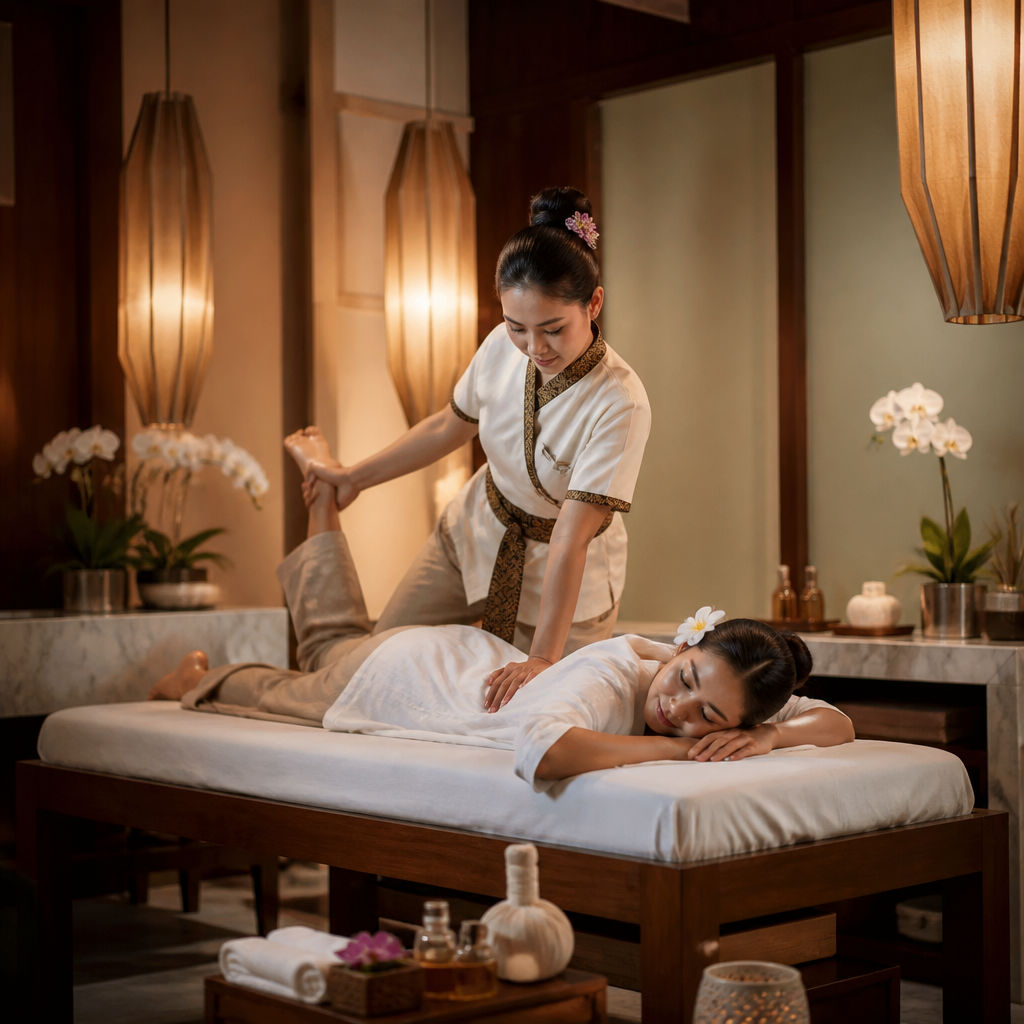
Thai oil massage is the table-based, oil-lubricated treatment most Thai shops offer alongside the classical clothed style. Technique is closer to Western Swedish massage than to nuat phaen thai: long gliding strokes, kneading, circular thumb work and rhythmic squeezing, applied directly to skin with a neutral carrier oil or a lightly scented blend. Pressure is usually light to medium and the pace is continuous rather than punctuated by holds. You undress to your comfort level, are draped with a towel or sheet, and only the area being worked is uncovered. Many Thai therapists blend the two traditions in practice, so an oil massage in Thailand often includes thumb pressure along sen line routes and a few gentle stretches that a European masseur would not use. It is the default choice for anyone who wants something sedative and skin-level rather than the leaning, folding intensity of a floor session.
How it is done: Thai Oil Massage
The therapist works on a padded table, warms oil in the hands and establishes contact with effleurage — long, broad, gliding strokes that spread lubricant, warm the tissue and let the therapist read where the body is tight. Petrissage follows: kneading, lifting, rolling and squeezing muscle bellies, particularly on calves, hamstrings, glutes, erector spinae and the upper trapezius. Friction is applied with thumbs, fingertips or a supported thumb into specific tight bands and trigger points, held or worked in small circles. Some therapists include gentle percussive tapotement and rhythmic rocking. Because oil removes friction, pressure is transmitted along the tissue rather than pinned in place, which is what makes the sensation flowing rather than static. A Thai therapist will commonly interleave thumb-walking along sen routes on the legs, back and arms — sustained perpendicular pressure held through an exhalation, borrowed straight from the clothed tradition — and may add light ankle rotation, shoulder circling or a mild spinal twist near the end. Order is conventional: prone back and legs first, then posterior neck and shoulders, then you turn supine for anterior legs, arms, hands, chest border, shoulders and finally scalp and face. Draping is repositioned each time an area changes. Pressure is negotiated: say so early if you want more or less, because the therapist calibrates in the first few minutes and holds that level.
Who it suits: Thai Oil Massage
It is used mostly for relaxation, generalised muscular tension, stress relief and sleep quality, and for people who find the clothed Thai style too intense. Because it works directly on skin and superficial muscle with sustained warmth and pressure, it suits sore, overworked muscles, tight calves after long walking days, and desk-related upper-back tightness. Many people report reduced perceived pain and anxiety immediately afterwards, and short-term drops in heart rate and blood pressure have been measured in massage studies generally. The skin-conditioning effect of the oil is a small real benefit in Thailand's climate and after sun exposure. It is not a treatment for structural injury, and the sensation of tension being 'released' does not mean fascia or scar tissue has been physically remodelled — that framing is common in spa literature and is not well supported. Treat it as a pleasant, reasonably effective short-term intervention for muscular discomfort and stress rather than a therapy.
How long to book
60 or 90 minutes are standard, with 120-minute versions widely available; 30-minute back-and-shoulder oil sessions are common as add-ons or lunchtime treatments.
What it costs
Street and local shops: roughly 300-500 baht per hour, with 120 minutes around 600-800. Mid-market shops: roughly 500-900 baht per hour, 120 minutes around 900-1,800. Hotel and boutique spas: roughly 1,000-2,000 baht per hour, with luxury properties in Bangkok, Phuket and Samui reaching 2,500-4,000 or more.
Safety: who should be careful
Tell your therapist about medical conditions, medications and allergies before you undress. Skin is the immediate issue: avoid oil massage over sunburn, eczema flares, open wounds, infections, recent tattoos, fungal conditions or any undiagnosed rash, and mention nut allergies since many carrier oils are nut-derived. Ask a doctor first if you are pregnant, are on anticoagulants or bruise easily, have varicose veins, have had recent surgery, or have any history or risk of deep vein thrombosis — firm work on the legs is not appropriate over a possible clot. Uncontrolled hypertension, unstable cardiac disease, fever or acute illness are reasons to postpone. If you have osteoporosis or fragile bones, ask for light pressure and no percussive work. Cancer patients should clear massage with their oncology team; gentle work is often supported but pressure over tumour sites, treatment fields or lymphoedematous limbs is not. Recent injury, acute inflammation and swelling should be left alone. Say something during the session if pressure hurts sharply rather than enduring it.
What the evidence says
Evidence for oil-based massage is broader than for the Thai-specific modalities because it overlaps with the international Swedish massage literature, but it is not strong. Sritoomma and colleagues (2012) reviewed Swedish and traditional Thai massage for chronic low back pain across six studies and found them roughly comparable in effect, while noting methodological limitations. Broader massage reviews consistently report modest short-term improvements in pain and anxiety with limited evidence for lasting change. The core problem is unfixable by design: participants know whether they are being massaged, so blinding fails and expectation, therapist attention and touch itself all contribute to measured benefit. Where oil massage is combined with essential oils, the Cochrane review by Shin and colleagues (2016) covering 19 studies and 1,274 participants with cancer rated the evidence very low quality and concluded any measured benefit was unlikely to translate into clinical benefit. Reasonable conclusion: good for how you feel in the short term, unproven for anything more.
Professional Insight
Thai oil massage is done on a table, using oil for continuous gliding strokes with gentle kneading. Nuad Thai School recommends it for first-time spa-goers and anyone after stress relief; pick traditional Thai instead if you want stretching and deep muscle release.
— Nuad Thai School, Bangkok (school's published guidance; no individual author named) Source
Where to get thai oil massage
99 Thai Massage Huahin — Central Hua Hin
A Serene Beach Spa - Koh Samui — Taling Ngam
Absolute Sanctuary — Choeng Mon · from 1,600 THB
All Day Massage And Sea — Ao Nang
Amburaya Spa, InterContinental Pattaya — Pratumnak Hill · from 1,890 THB
Ana Anan Resort Spa — Jomtien · from 1,200 THB
Anantara Spa Hua Hin — Beach resort strip · from 2,400 THB
Anantara Spa at Anantara Bophut — Bophut · from 3,900 THB
See all 179 shops offering thai oil massage →
Thai Oil Massage by city
Bangkok · Pattaya · Phuket · Chiang Mai · Hua Hin · Krabi · Koh Samui
Wellness guides
Thai Massage for Stretching: What Helps, What the Evidence Says — Does Thai massage make you more flexible? What assisted stretching can and cannot do, what the small trials found, and who should skip the deeper stretches.
Thai Massage for Recovery: What Helps, What the Evidence Says — Can Thai massage speed recovery after hard exercise, treks or long journeys? What studies on soreness and fatigue found, and when to rest or see a doctor.
Thai Sports Massage: What Helps, What the Evidence Says — Thai sports massage before and after training: what it can do for soreness and flexibility, why it will not boost performance, and how to book it safely.
Thai Massage for Muscle Pain: What Helps, What the Evidence Says — Can Thai massage ease back, neck and shoulder pain? What Thai trials and Cochrane reviews found, how long relief lasts, and warning signs that need a doctor.
Thai Massage for Sleep: What Helps, What the Evidence Says — Can a Thai massage help you sleep better? What the small Thai trials found, which styles suit an evening session, and when poor sleep needs a doctor, not a spa.
Thai Massage for Stress Relief: What Helps, What the Evidence Says — Does Thai massage really reduce stress? What trials on anxiety, heart rate variability and cortisol found, which styles relax most, and when to seek more help.
Other massage types
Aromatherapy Massage · Foot Massage and Thai Reflexology · Head and Shoulder Massage · Herbal Compress Massage · Sports Massage · Tok Sen Massage · Traditional Thai Massage