Home › Massage Types › Herbal Compress Massage
Herbal Compress Massage
นวดประคบสมุนไพร (nuat prakop samunphrai, 'herbal compress massage'); the compress ball itself is ลูกประคบ (luk prakop)
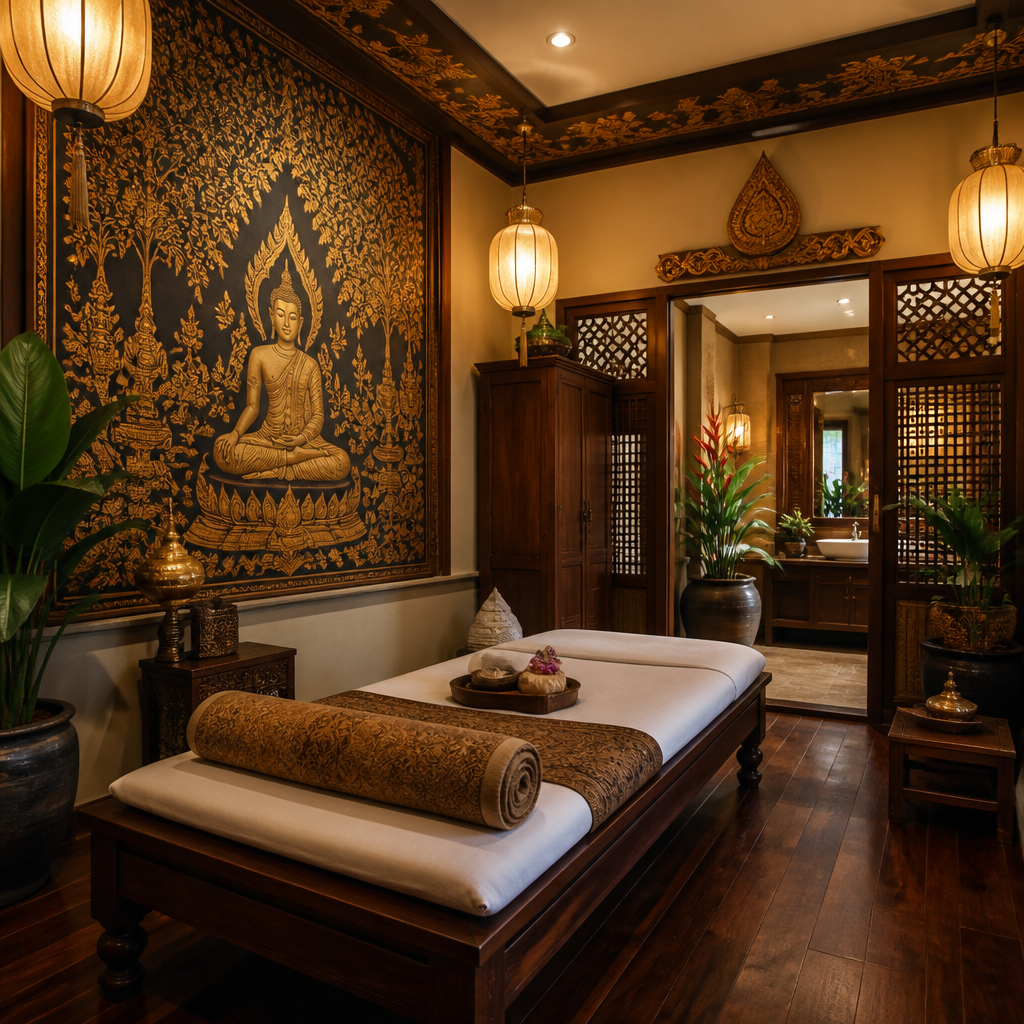
Herbal compress massage uses a muslin bundle packed with Thai medicinal plants, steamed until hot, and pressed rhythmically over the body. The bundle — luk prakop — is roughly the size of a large orange with a twisted cloth handle, and is filled with plai, turmeric, lemongrass, kaffir lime, galangal, camphor and tamarind leaf, among other regional variations. Steaming releases aromatic oils and heat together, so the treatment delivers warmth, herbal scent and firm pressure at once. Therapists work with two compresses in rotation, one in use while the other reheats, and press, roll and dab rather than glide. It is almost never sold alone: a session typically opens with 20 to 30 minutes of traditional Thai or oil massage to warm the tissue, then the compresses come out. The first contact is often startlingly hot, and testing the temperature against your skin is part of the routine.
How it is done: Herbal Compress Massage
Herbs are chopped, mixed and tied tightly into a cotton or muslin square, then steamed for around fifteen to twenty minutes until the bundle is hot and saturated with aromatic vapour. The therapist works with two, swapping as one cools. Application is not stroking: it is pressing, rolling, dabbing and rotating. The therapist first tests the bundle on their own forearm, then contacts your skin with quick light dabs to check tolerance, then increases dwell time as the compress cools and your skin adapts, holding it in place for several seconds over broad muscle areas. Compresses are rolled along the erector spinae, pressed into shoulders and glutes, run down the backs of the legs, and held over specific tight points. Three mechanisms are usually cited and only two are solid: moist heat, which reliably increases local tissue temperature, reduces the sensation of stiffness and is comfortable on tight muscle; mechanical pressure, essentially compression massage delivered through a soft tool; and transdermal herbal action, which is the least established of the three. Order matters. Manual massage comes first to warm and prepare tissue, then the compress phase runs 40 to 60 minutes over back, shoulders, legs, arms and sometimes abdomen, then a short closing sequence on neck, shoulders and scalp. Some therapists finish by pressing a cooled compress over the face and letting you inhale it.
Who it suits: Herbal Compress Massage
It is used for muscular stiffness, aches, low back and shoulder tightness, post-exertion soreness and joint discomfort — anywhere moist heat plus firm pressure would plausibly help. Traditional Thai practice also uses compresses in postpartum care and for menstrual discomfort. The heat itself is the most dependable element: local warming genuinely eases the sensation of stiffness and makes tight muscle more comfortable to work with, which is why the compress phase usually follows manual massage rather than replacing it. Many people find the combination of warmth, weight and aroma unusually settling, and it is a popular choice in the cool season and for anyone who finds standard Thai massage too sharp. The herbal constituents have some pharmacological rationale, though how much active compound crosses the skin during a treatment is unclear. It is not a treatment for arthritis, injury or inflammatory disease, and it should not be described or sold as one.
How long to book
90 minutes is the most common format, usually 30 minutes of manual massage plus 60 with compresses; 60- and 120-minute versions are widely offered. Compresses are also sold as a 30-minute add-on to a Thai or oil massage.
What it costs
Street and local shops: roughly 400-700 baht for 60-90 minutes, often with a small surcharge for the compress itself. Mid-market shops: roughly 800-1,500 baht for 90-120 minutes. Hotel and boutique spas: roughly 1,500-3,100 baht — a well-known Chiang Mai spa charges around 1,600 baht for 60 minutes and 3,100 for 120. Take-home compress balls sell for around 50-150 baht in herbal shops.
Safety: who should be careful
The heat is the distinguishing risk, so tell your therapist about anything affecting circulation, sensation or skin. Ask a doctor first if you have diabetes or any peripheral neuropathy, since reduced sensation means you may not feel a burn developing. Do not have compresses applied over sunburn, open wounds, eczema, rashes, infections, recent tattoos, varicose veins, acute swelling or any inflamed, hot or recently injured area — heat on acute inflammation makes it worse. Seek medical advice before booking if you are pregnant, particularly in the first trimester, or have cardiovascular disease, uncontrolled hypertension, a heart condition, fever, or any history or risk of deep vein thrombosis. Herbal allergy is a real possibility: mention allergies to ginger, turmeric or plant products, and ask for a patch test if your skin is sensitive. If you have cancer or are in treatment, discuss it with your oncology team first. Say something immediately if a compress feels too hot — burns are the main reported adverse event and are entirely preventable by speaking up.
What the evidence says
This is the Thai modality with the most direct clinical study, and the results are modest. Dhippayom and colleagues (2015, Evidence-Based Complementary and Alternative Medicine) conducted a systematic review and meta-analysis of Thai herbal compress and found it broadly comparable to standard comparators for musculoskeletal pain, while noting small trials and quality limitations. Worasing, Sungthong and Phimarn (2023, Scientia Pharmaceutica) updated this specifically for Zingiber montanum (plai) compress across six randomised trials and 812 patients: pain was significantly reduced compared with placebo (SMD −0.63), but there was no significant advantage over NSAIDs, and improvements in flexibility and quality of life were comparable to placebo. The authors flagged high heterogeneity, few trials, no standardised preparation and an absent safety profile. A separate randomised trial in elderly patients with low back pain compared traditional Thai massage against massage with herbal compress. Fair reading: some genuine evidence for short-term pain relief, none for disease modification, and formulation inconsistency limits generalisation.
Professional Insight
Skip the hot herbal compress on a fresh injury: Abhai Wellness's Thai traditional medicine doctors advise against it in the first 24 hours, when heat may increase swelling and a cold compress is better, and with fever above 38.5°C, open wounds or fresh bleeding.
— Abhai Wellness, Applied Thai Traditional Medicine Clinic, Bangkok (clinic's published guidance; staffed by Thai traditional medicine doctors, none named on the page) Source
Where to get herbal compress massage
7 Spa Luxury Pattaya — Thappraya Road · from 2,750 THB · open late
Anantara Spa at Anantara Chiang Mai Resort — Chang Klan
Anantara Spa at Anantara Riverside Bangkok — Riverside · from 1,950 THB
Asia Herb Association — Benchasiri Park — Phrom Phong · from 700 THB · open late
Asia Herb Association — Sukhumvit 24 — Phrom Phong · from 700 THB · open late
Asia Herb Association — Sukhumvit 4 (Nana) — Nana · from 700 THB · open late
Aura Thai Massage — Phuket Town (Wichit) · from 350 THB · open late
Baan Hom Samunphrai — Saraphi (outskirts) · from 1,000 THB
See all 77 shops offering herbal compress massage →
Herbal Compress Massage by city
Bangkok · Pattaya · Phuket · Chiang Mai · Hua Hin · Krabi · Koh Samui
Wellness guides
Thai Massage for Recovery: What Helps, What the Evidence Says — Can Thai massage speed recovery after hard exercise, treks or long journeys? What studies on soreness and fatigue found, and when to rest or see a doctor.
Thai Sports Massage: What Helps, What the Evidence Says — Thai sports massage before and after training: what it can do for soreness and flexibility, why it will not boost performance, and how to book it safely.
Thai Massage for Muscle Pain: What Helps, What the Evidence Says — Can Thai massage ease back, neck and shoulder pain? What Thai trials and Cochrane reviews found, how long relief lasts, and warning signs that need a doctor.
Other massage types
Aromatherapy Massage · Foot Massage and Thai Reflexology · Head and Shoulder Massage · Sports Massage · Thai Oil Massage · Tok Sen Massage · Traditional Thai Massage