



10 Questions to Ask Before Choosing a Thai Massage Therapist

Most travelers arriving in Thailand book their first massage within 48 hours of landing. The price looks right, the signage looks professional, and the street is lined with options. But choosing a Thai massage therapist without asking a few targeted questions first is the single fastest way to end up with a painful, uncomfortable, or just deeply mediocre experience. This guide gives you the 10 questions that separate genuinely skilled, ethical practitioners from the rest. Ask them before you commit to a session, whether you are in Bangkok, Chiang Mai, Phuket, or anywhere else on your itinerary.
Table of Contents
Quick Takeaways
Key Insight
Explanation
Therapist certification is verifiable
Thai massage practitioners must be certified through Ministry of Public Health-accredited institutions. A legitimate spa will confirm this if asked.
Always see the price menu before sitting down
Reputable establishments display a written treatment menu. Verbal-only pricing is a red flag for post-session price switching.
Hygiene signals are visible on arrival
Fresh linens, clean floors, and a therapist who washes their hands before beginning are baseline expectations, not luxury extras.
"Experienced therapist" is a request you are allowed to make
Spas often rotate bookings automatically. Asking for a more experienced practitioner is completely acceptable and will not offend.
Pressure level must be agreed before the session starts
Thai massage can range from deeply intense to gentle and restorative. Neither end of the spectrum is automatically better. It must match your needs.
Upselling during a session is a warning sign
A professional therapist does not pitch additional paid services mid-treatment. Mid-session pressure tactics suggest the focus is revenue, not your wellbeing.
Street touts directing you to a shop undercut the quality signal
A commission-based referral system means the recommendation is about the referrer's fee, not the spa's standard. Choose independently.
Why These Questions Matter More Than Reviews Alone
Online reviews for Thai spas are genuinely useful, but they are also easy to game and impossible to verify. A venue can have four-and-a-half stars while routinely using undertrained therapists for walk-in clients. Reviews also cannot tell you whether the linen was fresh on the day you visit, whether the therapist assigned to your session has six months of experience or six years, or whether the quoted price on the website reflects what you will actually be charged at checkout.
The 10 questions below are how you find that out for yourself, before the session starts. They are not rude to ask. A professional establishment expects them. The spas that bristle or deflect when you ask about certification, pricing, or hygiene are telling you something important about how they operate.
How to find a good Thai spa is ultimately about knowing what a good one looks and feels like when you are standing at the front desk, not only what it reads like online. Use these questions as your filter.

Questions 1 to 3: Credentials and Training
Are your therapists certified through an accredited Thai massage program?
This is the most important question on the list, and it is the one most travelers skip entirely. In Thailand, traditional Thai massage practitioners are required to be certified through institutions accredited by the Ministry of Public Health. Recognised training programs commonly run from around 150 to 500 hours depending on the level of certification, and practitioners hold a certificate from an accredited school. Bodies such as the Union of Thai Traditional Medicine Society set and protect the standards that govern this.
The Wat Pho Thai Traditional Medical and Massage School in Bangkok is the most widely known institution, but many regional schools also produce certified practitioners. When you ask a spa whether their therapists are certified, a reputable venue will confirm this directly and without hesitation. If the receptionist looks confused by the question or gives a vague answer like "yes, they are all trained," follow up by asking which institution.
Pro tip: Pro tip: Ask to see a certificate if you are uncertain. A professional spa keeps therapist credentials on file. It is not an unusual request, and any establishment worth your business will respond without defensiveness.
How long has the therapist assigned to me been practicing?
Experience matters enormously in Thai massage. The technique involves applied pressure, assisted stretching, and joint mobilisation. A newly certified therapist and one with five years of daily practice are not equivalent in what they can safely and skillfully deliver. Most spas rotate bookings to distribute work evenly among their staff, which is fair for the therapists but does not automatically serve your interests as a client.
Asking for a more experienced therapist is entirely acceptable. You are not being difficult. You are paying for a service that has a direct physical effect on your body, and the skill level of the person performing it is directly relevant to what you will experience. Phrase it simply: "Could I be booked with one of your more experienced therapists, please?"
Does the spa specialise in traditional Thai massage, or is it a general wellness venue?
There is a practical difference between a venue that specialises in traditional Thai massage (Nuad Thai) and one that offers it as one of twenty treatments on a laminated menu. Specialists train their staff specifically, maintain the physical setup required for mat-based Thai massage, and are more likely to employ practitioners with deep technical knowledge of the form. A general wellness spa may offer excellent oil massage or aromatherapy while providing only a surface-level version of Thai massage. Knowing which type of venue you are walking into helps you calibrate your expectations correctly.
Questions 4 to 6: Hygiene, Environment, and Safety
Hygiene in a Thai massage setting is not a luxury concern. It is a health matter. The physical contact involved in a proper Thai massage session means that standards around linen, equipment, oils, and therapist preparation directly affect your wellbeing. The good news is that most of what you need to assess is visible on arrival, before a single baht changes hands.
Are linens and towels changed between every client?
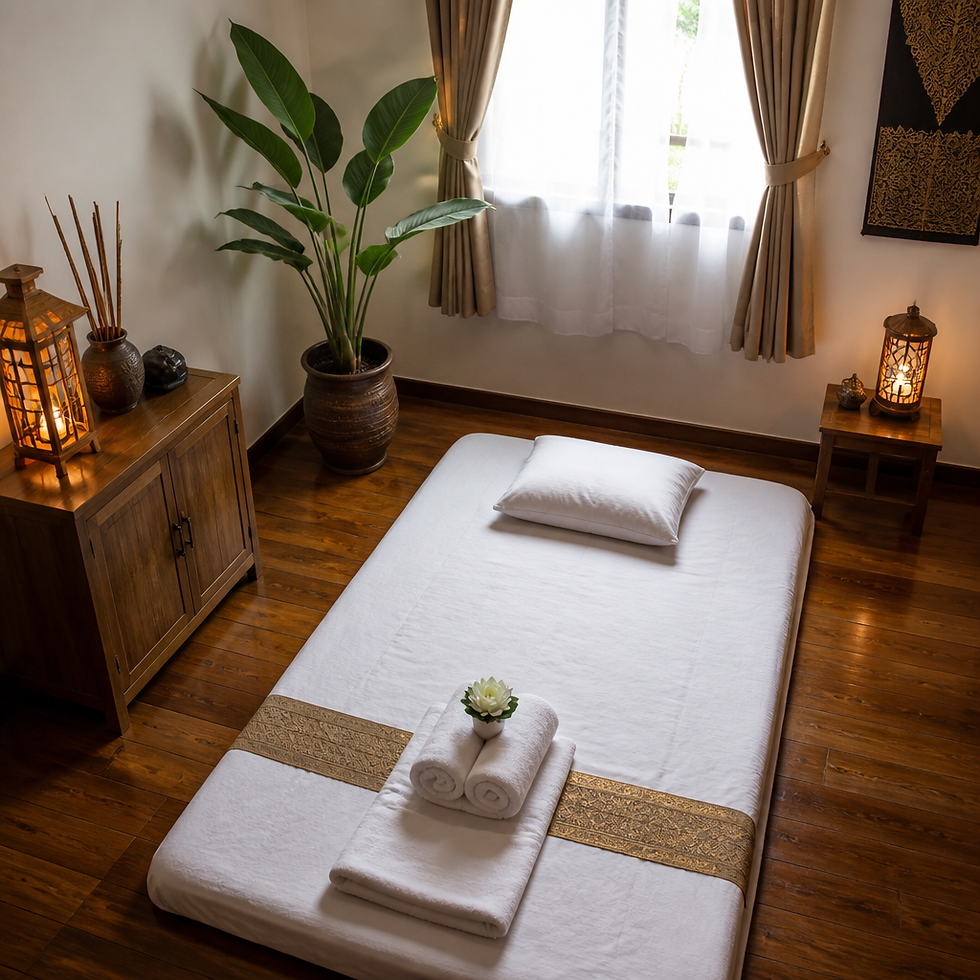
This should be non-negotiable, but it is worth confirming. Fresh linens, towels, and a fully prepared treatment surface after every single client are the baseline standard for any legitimate establishment. When you walk into the treatment room before booking, look at whether the mat or table appears freshly made up. A room that smells stale or has obviously used linens in it tells you what you need to know about the establishment's hygiene standards generally.
The things you cannot see matter too: whether the therapist washes their hands before beginning, whether herbal compress ingredients are fresh, and whether oil bottles are cleaned properly between uses. A venue that maintains visible cleanliness is generally consistent behind the scenes too. One that cuts corners on the visible parts is almost certainly cutting corners on the rest.
Pro tip: When you arrive at any new spa, ask to see the treatment room before confirming your booking. You can tell a great deal from a single glance. Any reputable establishment will show you without hesitation.
Do you have a written menu with fixed prices?
This question is partly about hygiene of a different kind: financial transparency. Reputable spas display a written treatment menu with clearly stated prices. A venue that quotes prices verbally, or only after you are already seated and have started filling out a form, is creating conditions for a post-session price switch. Ask to see the menu before you agree to anything.
Confirm the exact price for the session length you want, whether there are any additional charges (service fees, taxes, or add-ons you did not request), and whether the price you are quoted is the price you will pay. This is not distrust. It is standard practice, and professional venues will find it completely unremarkable.
Is there anything in my health history you need to know before we begin?
This question is one you ask yourself as much as the spa. Thai massage involves strong pressure and deep assisted stretching. It is contraindicated for certain conditions including recent surgery, pregnancy beyond the first trimester (and often throughout), active inflammation or injuries, and some cardiovascular conditions. A professional spa will ask you to complete a brief intake form before your session. If they skip this entirely and take you straight to the room without any health screening, be cautious.
Disclose your actual health situation. Do not assume the therapist will automatically accommodate something they do not know about. If you have a specific injury or physical sensitivity, say so directly and early. A skilled therapist will adjust their approach accordingly.

Questions 7 to 9: Pricing, Pressure, and Personalisation
What pressure level do you recommend for someone with my goals?
This is a practical question that opens a useful conversation. Traditional Thai massage can be applied at a wide range of intensities. The assumption that "it should hurt to work" is one of the most persistent misconceptions around Thai massage tips for travelers. Some discomfort during deeper work is normal. Pain that makes you tense, hold your breath, or feel like something is being forced is not.
Ask the therapist what they would recommend for your stated purpose, whether that is recovery from long-haul travel, general relaxation, or addressing specific tension in your back or shoulders. A therapist who listens to your answer and tailors their approach is practicing well. One who proceeds at a single intensity regardless of your feedback is not.
What is your policy if I am uncomfortable during the session?
Every reputable spa will tell you, without any prompting, that you can and should speak up if something feels wrong during your treatment. If a venue does not mention this and you do not ask, you may end up in the common situation of enduring pressure or techniques that are genuinely uncomfortable because you felt it would be rude to say something. It is not rude. It is necessary.
A little pressure is normal, but if it really hurts, say something. Therapists can and should adjust to your comfort level at any point during a session.
Ask before the session begins: "Is it fine to tell you during the massage if I want lighter or heavier pressure, or if I want you to avoid a specific area?" The answer should be yes, immediately and without qualification. This also applies to the end of the session. If something felt off or caused discomfort, you are entitled to raise it.
Will you be adding anything to my session that was not in the original booking?
Mid-session upselling is a recognised problem in some Thai spa settings. It takes several forms: a therapist suggesting an additional herbal compress treatment while you are on the mat, a receptionist mentioning upgrade options as you settle into the room, or additional charges appearing on the bill for items you did not explicitly request. A professional spa does not pressure clients for add-ons during their treatment. The session you booked is the session you receive.
Asking this question upfront sets a clear expectation. If you want add-ons, you will ask for them. Anything added without your explicit prior agreement should not appear on your bill. State this clearly and politely, and watch how the reception responds. A confident, ethical establishment will agree without hesitation.


Comments