



10 Thai Massage Etiquette Rules Every Visitor Must Follow

You booked a session at a highly recommended Bangkok spa, you're looking forward to your first real traditional Thai massage, and then you walk in wearing stiff jeans, forget to silence your phone, and accidentally point your feet at the therapist. The session is fine, but the experience never quite clicks. That disconnect is almost always caused by a gap in Thai massage etiquette, not a gap in the quality of the spa. Thailand's massage culture has deep roots in both healing tradition and social custom, and knowing the unwritten rules transforms a good treatment into an exceptional one. These ten rules will make sure you get it right from the moment you walk in.
Table of Contents
Quick Takeaways
Key Insight
Explanation
Shower before arriving
Arriving clean is considered basic courtesy. It shows respect for the therapist who will be working in very close physical contact with you.
Punctuality matters more than you think
Arriving at least 10 to 15 minutes early gives you time to fill in a consultation form and settle in without cutting into your actual treatment time.
Traditional Thai massage is done fully clothed
Wear loose, stretchy clothing or accept the spa-provided pyjama set. Tight jeans and structured fabrics block the assisted stretching that defines the treatment.
Speak up about pressure
Staying silent when pressure is too strong or too light is one of the most common mistakes visitors make. A single word is all it takes to adjust.
Tip your therapist in cash, directly to them
Leaving a tip on a table or adding it to a card payment does not guarantee it reaches the person who treated you. Hand it over with a smile.
The head is sacred, the feet are the lowest
Never touch or reach over a therapist's head, and avoid pointing your feet at people or sacred objects, even casually.
Silence your phone before you lie down
A ringing phone disrupts every person in the room, not just you. This is a non-negotiable courtesy in any reputable Thai spa.
Rule 1: Arrive Clean and On Time
Thai massage is hands-on, close-contact work. Your therapist will be leaning over you, pressing, stretching, and repositioning your body for anywhere from one to two hours. Arriving fresh from the shower is not a formality, it is the most basic form of respect you can show to someone doing physical labor on your behalf. If you have been sightseeing, tuk-tuking, or temple-hopping all afternoon, take a few minutes to freshen up first.
Punctuality carries equal weight. Arriving 10 to 15 minutes before your appointment is the standard expectation at reputable spas across Thailand. That window gives you time to complete a health consultation form, change into provided clothing, and actually arrive mentally present rather than rushing from the street. If you are late, your treatment time is almost always cut short rather than extended, which means you pay the full price for a shortened session.
Pro tip: If your spa is in a busy district like Sukhumvit in Bangkok or the Old City in Chiang Mai, build in extra travel time. Traffic is unpredictable, and a late arrival is a courtesy failure, not just an inconvenience.


Rule 2: Wear the Right Clothing
Traditional Thai massage is performed fully clothed. The stretches, compressions, and joint mobilizations that define it require your body to move freely, which means that what you wear matters enormously. Tight jeans, fitted dresses, or any garment that restricts movement will actively work against the treatment.
Most established Thai spas provide a loose, pyjama-style set for you to change into before your session. Accept it. These garments are designed specifically to allow the range of movement that Thai massage demands. If you prefer to wear your own clothing, opt for loose linen trousers, yoga pants, or anything with real stretch.
What to Wear for Oil and Aromatherapy Treatments
Oil-based treatments follow different rules. For these sessions you undress to your comfort level, and the therapist keeps you covered with a towel or sheet at all times, uncovering only the area being worked on. You are never left exposed. Underwear stays on. Disposable underwear is often provided by the spa if you prefer to protect your own.
The common mistake is assuming all Thai massage sessions follow the same dress code. They do not. Confirm the format when you book so you arrive prepared.
Rule 3: Respect the Foot-Washing Ritual
Many traditional Thai massage establishments, particularly the more culturally rooted ones, begin the session with a foot wash. This is not a luxury add-on. It is a ritual with genuine cultural and hygienic roots, reflecting the significance of cleanliness before a healing treatment begins.
Take the process seriously. Clean your feet thoroughly and do not rush through it. Once done, dry them gently with the towel provided. Treating the foot wash as an interruption to hurry through signals to the therapist that you are not fully present in the experience.
In practice, guests who engage with the foot-washing ritual with care tend to settle into their sessions more quickly. The ritual itself functions as a mental transition from tourist mode to wellness mode, and that shift has a real effect on how much you benefit from what follows.
Rule 4: Understand the Head and Feet Hierarchy
Thai culture holds a clear view of the body's hierarchy. The head is the highest and most sacred part of the body. The feet are the lowest and considered least clean. This belief shapes real behavioral expectations inside and outside the massage room.
In Thai culture the feet are seen as the lowest and least clean part of the body, while the head is treated as the highest and most sacred. Because of this, you avoid pointing your feet at people or shrines and never touch or reach over someone's head.
Inside a spa, this means you should never casually stretch your legs out in a way that points your feet directly at your therapist or at any decorative shrine in the room. You should also never reach over a therapist's head, touch their head, or make a joke of patting someone on the head. Your therapist working on your feet during the session is perfectly normal and part of the treatment. That is different from you casually directing your feet at them.
Pro tip: When sitting in a waiting area, be conscious of where your feet are pointing. Crossing your legs so that your feet face away from other people is a simple adjustment that shows cultural awareness without any awkward explanation.
Rule 5: Disclose Health Conditions Before You Start
Thai massage involves deep compression, assisted stretching, and joint mobilization. It is not gentle in the way a light Swedish massage is gentle. If you have recent injuries, chronic conditions, surgery recovery, pregnancy, high blood pressure, or any physical limitation, your therapist needs to know before they begin, not during the session.
This is not about liability paperwork. It is about giving the therapist the information they need to adapt the treatment to your body. A skilled practitioner will modify their approach once they know what they are working with. Staying silent about a herniated disc and then yelping when a stretch hits it serves no one.
What to Disclose and What Happens Next
Be specific. Tell them which side, which area, and what movements aggravate it. Good therapists will thank you for the detail. Most reputable spas across Thailand will have a short consultation form at the start of your visit. Fill it in accurately rather than checking boxes at random to speed through the admin.
Rule 6: Communicate Pressure During the Session
This is the rule that most first-time visitors get wrong. They lie in silence while the pressure is too strong or too light, endure the full session, and then leave feeling that the massage did not meet expectations. The entire problem was self-inflicted.
In Bangkok and throughout Thailand, communicating pressure during a session is completely normal. Many spas actively encourage it because it is one of the most common first-time concerns. There is no need for lengthy explanation. A simple "softer please" or "harder please" is enough. The therapist will adjust immediately and without offense.
Traditional Thai massage can feel intense. Deep compressions on the legs and assisted stretches on tight hips can register as significant pressure. The distinction to watch for is between productive intensity and pain that makes your body brace. If you are holding your breath or clenching your jaw, the pressure is too strong. Say something.
Rule 7: Stay Quiet and Put Your Phone Away
Thai massage is designed to create a quiet, restorative environment. The ambient silence is not accidental, it is the point. Talking through your session, whether on your phone or with the therapist, disrupts that environment for everyone in the room, not just you.
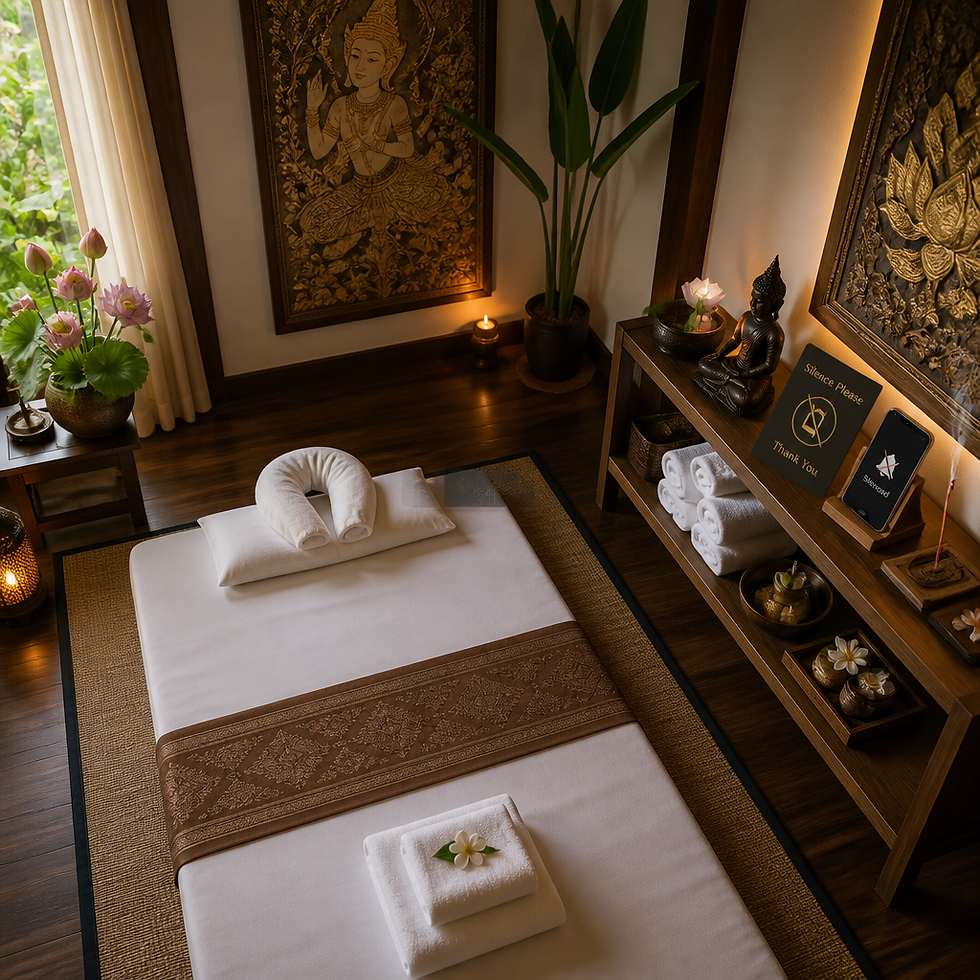
Silence your phone completely before you lie down. Not vibrate mode. Off. A buzzing phone sitting on a shelf nearby is still a distraction that pulls you out of the present moment every time it pulses. Checking messages mid-session is considered particularly disrespectful in traditional establishments.
Brief communication about pressure or comfort is always acceptable and expected. Extended conversation is not. If you want to chat with your therapist, save it for the reception area before or after the session. During the treatment, let them focus.
Rule 8: Return the Wai Greeting
The wai is the traditional Thai greeting. It involves pressing your palms together at chest level and bowing your head slightly toward your hands. Your therapist will likely offer it at the start and end of your session. Return it.
You do not need to be perfect. Thai people working in the tourism and wellness industry greet hundreds of international visitors and they are not judging your technique. What they notice is whether you acknowledge the greeting at all. Ignoring a wai or responding with a handshake instead reads as dismissive, even if that is not your intent.
A genuine wai back, followed by "khop khun kha" (if you are female) or "khop khun khrap" (if you are male), meaning thank you, is a small gesture that carries real cultural weight. Therapists across the country consistently respond to it warmly.
Rule 9: Tip Your Therapist Directly
Tipping is not legally required in Thailand, but it is widely understood as standard practice in the massage and spa industry, and it matters to the people who provide the service. The norms are well established: for a session you were happy with, a tip in the range of 50 to 100 baht is the common benchmark for standard sessions. At upscale spas, or for longer or particularly outstanding work, 100 to 200 baht is more appropriate.
The method matters as much as the amount. Hand the tip directly to your therapist with a smile. Do not leave it on a treatment table, do not add it to a card transaction, and do not hand it to front desk staff to pass on. None of those methods guarantee it reaches the person who actually treated you.
Pro tip: Carry small denomination baht notes whenever you plan to visit a spa. Arriving at the end of a session without any cash and asking the front desk to add a tip to your card is awkward for everyone and often results in the therapist receiving nothing.
Etiquette Comparison: Traditional, Oil, and Upscale Spa Thai Massage
Not every Thai massage experience follows the same etiquette framework. The setting, the style, and the type of establishment all shape what is expected of you as a guest. Understanding the differences prevents common missteps.
Factor
Traditional Thai Massage (Street or Parlour)
Thai Oil or Aromatherapy Massage
Upscale Spa Setting
Clothing
Fully clothed; spa pyjamas or your own loose clothing provided or worn
Undressed to comfort level; draped with towel throughout
Robe and provided spa attire from arrival; strict modesty protocol
Arrival timing
Walk-in accepted; punctuality still appreciated
Appointment recommended; arrive 10 minutes early
Arrive 15 minutes early minimum; consultation form expected
Tipping
50 to 100 baht for a standard session
50 to 100 baht; more for longer sessions
100 to 200 baht or more; cash directly to therapist
Noise and phones
Keep quiet; phones off; brief pressure communication fine
Same standard; softer environment expected
Strict quiet policy; phones must be silenced on entry
Cultural greeting
Wai greeting common; reciprocate warmly
Wai greeting common; reciprocate warmly
Wai at start and end; more formal pacing throughout
Rule 10: Respect the Session as a Professional Wellness Treatment
Thai massage has a documented history reaching back centuries, with roots in Ayurvedic and Buddhist healing traditions. The therapists practicing it have trained in techniques passed down through lineages of practitioners. Walking into a session with the attitude that you are paying for a service and therefore the rules do not apply to you is the fastest way to have a poor experience.
Respect means not trying to direct the therapist's technique unless it relates to your comfort or safety. It means not making inappropriate requests. It means not treating the session as a social activity or a photo opportunity. And it means recognizing that the person working on your body is a skilled professional, not a service worker performing a routine task.
Staying Relaxed Is Part of the Etiquette
First-time visitors often stay rigid out of anxiety about doing something wrong. That tension works against the entire point of the treatment. The etiquette of Thai massage is not a test to pass. It is a framework for mutual respect that, once understood, lets you relax completely and receive the full benefit of the session.
The most authentic Thai massage experiences, whether at a no-frills parlour on a Chiang Mai side street or a premium wellness retreat in Koh Samui, share the same underlying social contract: the therapist brings skill and care, and the guest brings presence, cleanliness, and basic courtesy. That exchange, when both sides honor it, is what makes Thai massage genuinely different from a standard massage anywhere else in the world.
Frequently Asked Questions
Is it rude to fall asleep during a Thai massage?
Falling asleep is not considered rude at all. It is actually a compliment to the therapist, signaling that you are relaxed and trusting the treatment. The only thing to be aware of is that some of the assisted stretches during traditional Thai massage require your passive cooperation, so a very deep sleep can make the session less effective technically. Light dozing is perfectly fine.
Do I have to accept the assisted stretching during traditional Thai massage?
No. You can and should communicate any discomfort with specific positions or stretches before or during the session. If a stretch feels unsafe for your body, say so. Good therapists will respect your limits without any frustration. Disclosing flexibility limitations or injuries beforehand gives the therapist the context to adjust without you having to speak up mid-session.
Should I shower at the spa or shower before I arrive?
Shower before you arrive. The expectation is that you come to the session already clean, not that you use the spa's facilities to get clean first. Some higher-end wellness retreats provide showers as part of a longer spa day experience, but for a standard massage appointment, arriving fresh from your own shower is the correct approach.
What do I do if I am uncomfortable with how the therapist is touching me?
Say something immediately and clearly. You are always within your rights to redirect, limit, or end a session if you feel uncomfortable. Reputable Thai spas maintain professional standards, and any therapist at a legitimate establishment will respect a clear boundary. If a request is ignored, speak to the reception staff. You are not obligated to continue any session that makes you feel unsafe.
Is it acceptable to request a therapist of a specific gender?
Yes, and most established spas across Thailand accommodate this request without any awkwardness. Simply state your preference when booking or when you arrive at reception. It is a normal and common request, particularly for female travelers visiting for the first time. Making the request in advance gives the spa the best chance of matching you appropriately.
What does "spa etiquette Thailand" actually require that is different from a Western spa?
The main differences are the cultural layer around body hierarchy, the foot-washing ritual, the wai greeting, and the expectation that tipping goes directly to the therapist rather than into a general pool. Western spa etiquette covers the basics of cleanliness, punctuality, and quiet, all of which apply here too. Thai spa etiquette adds the cultural customs on top of those foundations, and those customs are worth understanding before you arrive rather than learning by mistake during the session.
Have you visited a Thai spa recently or are you preparing for your first session? Share what questions or surprises you encountered below, your experience could help another reader prepare.
References
Complete guide to Thai massage etiquette covering clothing, tipping, and cultural customs
Bangkok spa etiquette guide on pressure communication, tipping ranges, and what to wear
Thai massage etiquette for foreigners covering foot-washing rituals and session behavior
Proper spa etiquette in Chiang Mai including attire, punctuality, and treatment protocols
Thailand cultural etiquette guide covering tipping customs and social norms for visitors


Comments